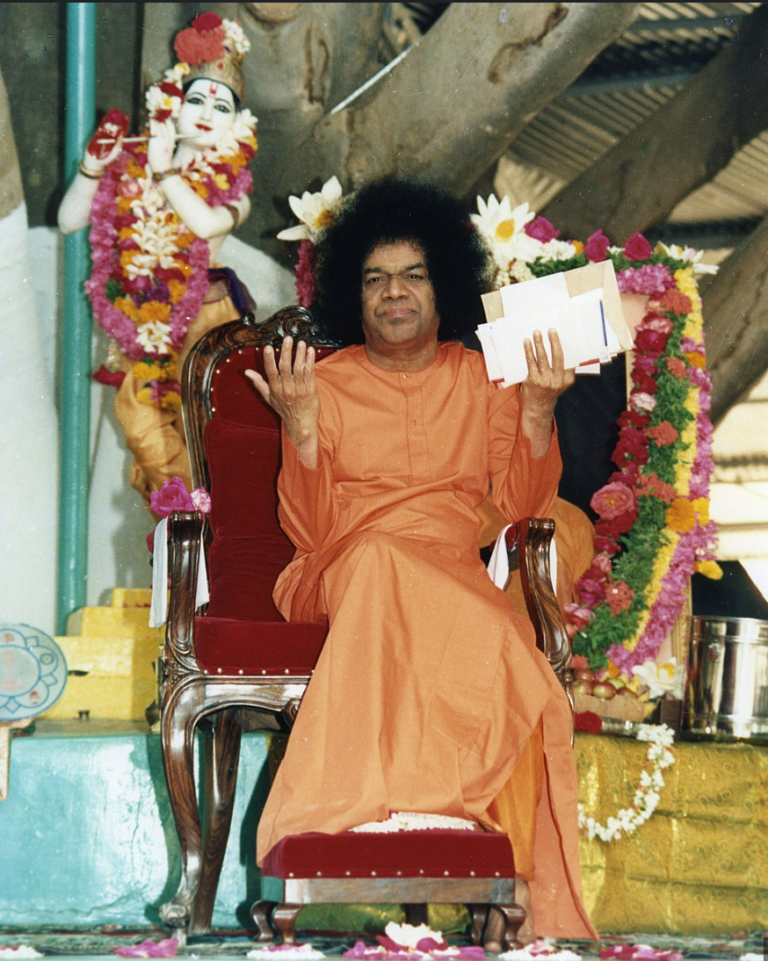
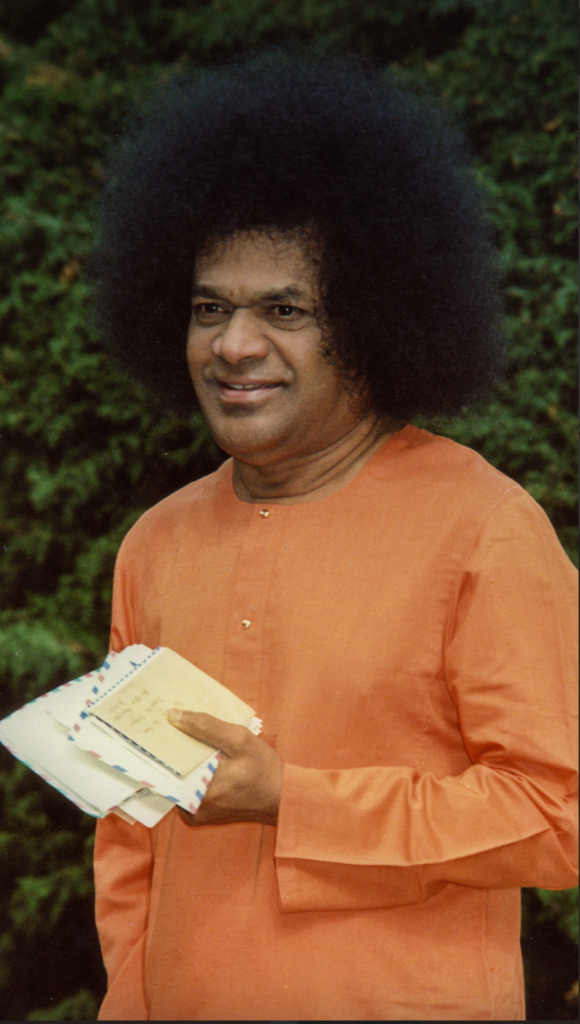
In the quiet village of Puttaparthi in Andhra Pradesh, a spiritual revolution began that would touch millions of lives across continents. Bhagawan Sri Sathya Sai Baba (1926-2011), through his extraordinary life and humanitarian work, demonstrated that the ancient Vedantic principle of “Ekam Sat” – Truth is One – is not merely philosophy, but a practical blueprint for transforming human civilization.
A Life of Service

What distinguished Sai Baba was not just his spiritual teachings, but his unwavering commitment to translating ancient wisdom into concrete action. His humanitarian empire, built entirely on voluntary donations and selfless service, stands as a testament to what pure intention can achieve.
The Sri Sathya Sai Institute of Higher Medical Sciences provides world-class healthcare absolutely free of charge. Complex cardiac surgeries, organ transplants, and advanced treatments that would cost lakhs elsewhere are offered without expecting even a rupee in return. Since its establishment, the hospital has performed over 100,000 free surgeries. In a world where healthcare is increasingly commercialized, this institution embodies the radical notion that healing is a fundamental human right, not a commodity.
His water projects transformed parched regions of Andhra Pradesh and neighboring states. The Sri Sathya Sai Water Supply Project brought clean drinking water to over 1.2 million people across 750 villages. This wasn’t charity; it was dignity restored, diseases prevented, and lives fundamentally altered.
The Sri Sathya Sai University, offering free education from primary to doctoral levels, has produced thousands of graduates who carry forward the philosophy of service. Here, education integrates academic excellence with character development, producing not just professionals but compassionate human beings.
The Vedantic Vision: We Are One

At the heart of Sai Baba’s teachings was the profound Vedantic truth: “Ekam Sat Viprah Bahudha Vadanti” – Truth is One, the wise call it by many names. This wasn’t religious syncretism; it was a declaration of the fundamental unity underlying all existence.
He taught that the divine essence pervading the cosmos is the same consciousness residing in every human heart. The apparent diversity – of religions, races, nationalities, and beliefs – is merely the surface ripple on an ocean of unified consciousness. As he famously declared, “There is only one religion, the religion of Love; only one caste, the caste of Humanity; only one language, the language of the Heart.”
This philosophy directly echoes the Upanishadic wisdom of “Tat Tvam Asi” (Thou Art That) and “Aham Brahmasmi” (I am Brahman). Sai Baba made these esoteric concepts accessible: recognizing divinity in oneself naturally leads to recognizing it in all beings. When one truly internalizes this truth, discrimination, hatred, and violence become impossible.
Timeless Wisdom in Simple Words

Sai Baba possessed a remarkable gift for distilling profound Vedantic truths into pithy, memorable aphorisms that anyone could understand and apply. “The end of wisdom is freedom; the end of culture is perfection; the end of knowledge is love; the end of education is character.” He transformed the complex Upanishadic teaching of “Neti Neti” (not this, not this) into the practical guidance: “Start the day with love, fill the day with love, end the day with love – this is the way to God.” The Bhagavad Gita’s teaching on karma yoga became: “Hands that help are holier than lips that pray.” The principle of self-inquiry taught by Ramana Maharshi found expression in his question: “Who am I? I am not the body, I am not the mind, I am the eternal Atma.” Through such crystalline simplicity, he made the eternal wisdom of the sages accessible to a rickshaw driver and a professor alike, proving that profound truth need not be obscure.
The Five Human Values
Sai Baba crystallized Vedantic wisdom into five universal human values: Truth (Sathya), Right Conduct (Dharma), Peace (Shanti), Love (Prema), and Non-violence (Ahimsa). These weren’t abstract ideals but practical guideposts. Truth meant alignment between thought, word, and deed. Right conduct meant acting with integrity regardless of circumstances. Peace was the inner stillness achieved through self-inquiry. Love was recognizing one’s self in all. Non-violence extended beyond physical harm to include harsh words and harmful thoughts.
The Ceiling on Desires Program
One of his most practical teachings was the “Ceiling on Desires” program, encouraging people to limit consumption of food, money, time, and energy, redirecting saved resources toward service. This anticipated contemporary concerns about sustainability and conscious consumption by decades, rooting ecological wisdom in spiritual understanding.
A Universal Message
What made Sai Baba’s approach revolutionary was his insistence that spirituality transcends religious boundaries. His ashram welcomed people of all faiths. Christians, Muslims, Hindus, Buddhists, and people of no faith found space there. He taught that different religions are different paths up the same mountain – the destination being realization of one’s true divine nature.
He challenged his devotees: “Why fear when I am here?” This wasn’t fostering dependency but encouraging inner strength. The “I” he referred to was not limited to his physical form but the eternal consciousness within each being.
The Living Legacy

Today, the Sai organizations continue their work across education, healthcare, and disaster relief in over 126 countries. But his true legacy isn’t measured in institutions or infrastructure. It lies in the hearts of millions who learned that service to humanity is worship of the divine, that love has no boundaries, and that the ancient Vedantic truth of oneness isn’t archaic philosophy but humanity’s only hope for survival.
In an era fractured by religious fundamentalism, nationalism, and division, Bhagawan Sri Sathya Sai Baba’s life and message offer a luminous alternative: a world where we recognize our shared divine essence, where helping another is helping oneself, where love dissolves all barriers.
“Love all, Serve all; Help ever, Hurt never” – in these simple words lies the complete teaching, the essence of Vedanta, and the pathway to individual and collective transformation.Retry